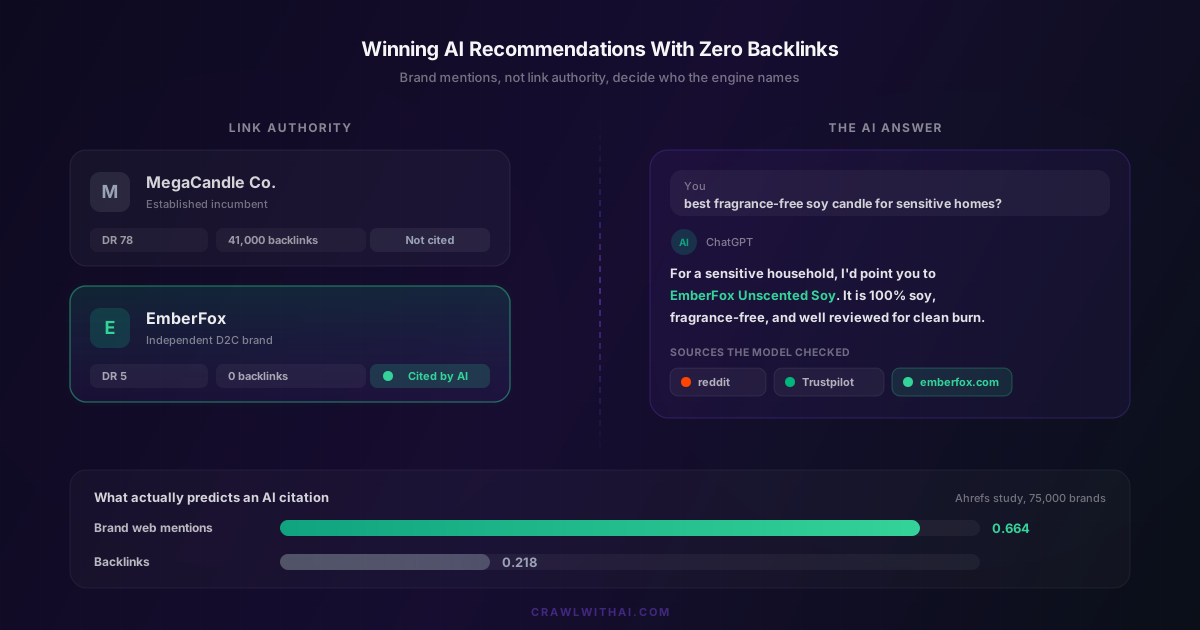
For twenty years, the playbook for getting found online had one non-negotiable line at the top: build backlinks. Links were the currency of authority, and a store with no links to its name was invisible. If you run a small direct-to-consumer brand, you have probably felt the wall this builds. You cannot outspend the incumbents on PR, you cannot buy your way onto authority sites, and your domain rating sits in single digits while a competitor sits at 78. On Google, that gap is mostly destiny. In AI recommendations, it barely counts.
Then AI search arrived and quietly broke the rule. ChatGPT, Perplexity, and Gemini now answer shopping questions by naming a handful of brands, and the brands they name are frequently not the ones with the biggest link profiles. A store with zero backlinks can win AI recommendations that a ten-year-old competitor never sees. That is not a glitch. It is how these systems are built. This post explains why backlinks barely move AI recommendations, and what actually does.
Why backlinks ruled Google and barely touch AI
Google's original breakthrough was PageRank, the idea that a link from one page to another is a vote of confidence. For two decades, more votes meant more authority meant higher rankings. The whole SEO industry grew up around acquiring those votes, and incumbents who started early stacked an advantage that compounds every year.
AI engines do not work that way. A large language model does not crawl the web and tally links before it answers. It generates a response from what it has learned about entities, products, and the language people use to describe them, then, for live queries, it pulls a small set of current sources to ground the answer. The question it is really asking is not "which page has the most votes," it is "which brand best fits what this person just asked, and can I find corroboration for naming it." Links are a weak proxy for that, and the data shows the engines treat them as such.
What the data actually says about backlinks and AI
This is not a hunch. Ahrefs studied 75,000 brands and measured which signals correlate with appearing in AI answers. Branded web mentions, simply being talked about across the web, correlated at 0.664. Backlinks came in at 0.218, more than three times weaker. Branded anchor text scored 0.527 and branded search volume around 0.392. Every off-site signal that beat backlinks was about being mentioned, not being linked.
The disconnect runs deeper when you look at where AI pulls sources. Analysis of ChatGPT's citations found roughly 80 percent of the pages it cites do not rank in Google's top 100 for the same query. The signals that earn a top Google ranking, links chief among them, are not the signals that get a page cited. A store that Google buries on page nine can still be the page ChatGPT quotes.
So if links are not the currency, what is. The honest answer is that AI engines reward being mentioned, being specific, and being machine-readable. None of those require a single backlink, which is exactly why a small D2C brand can win here.
Brand mentions beat backlinks, and you can earn them
The strongest predictor in the Ahrefs data, brand web mentions, is something you can build without ever asking for a link. A mention is any time your brand name appears in text the engine has read: a Reddit comment, a customer review, a comparison article, a forum answer, a YouTube transcript. The model does not need a clickable link to learn that EmberFox is the unscented candle people recommend for sensitive homes. It just needs to see the name attached to the claim, repeatedly, in places it trusts.
Those places matter more than their link value. Semrush analyzed which domains AI engines cite most and found Reddit at the top, appearing in roughly 40 percent of citations in its mid-2025 study, with Wikipedia around 26 percent. Reddit, Wikipedia, YouTube, and Forbes turned up among the most-cited sources in every sector. None of those is a backlink you build. They are conversations and references you earn by being a real brand people talk about. For a D2C store, that means showing up honestly in the subreddits where your buyers ask for recommendations, getting reviews on third-party profiles, and being included in independent roundups, none of which depend on your domain rating.
Specificity wins the slot a big brand cannot fill
Brand mentions get you into the candidate pool. Specificity gets you the recommendation. AI shopping prompts are long and full of constraints, and the engine names the brand that matches the most of them. A buyer does not ask for "a candle," they ask for "a fragrance-free soy candle for a sensitive household under twenty-five dollars." Every constraint eliminates a competitor.
This is where backlinks become irrelevant. A mass-market incumbent with 41,000 backlinks built a broad product to sell to everyone, so it fails at least one constraint in most specific queries. Your tight D2C line can satisfy all of them at once. The engine is not scoring authority on that query, it is scoring fit, and a focused brand has more fit than a giant. We dug into this in why AI recommends some unknown brands over established ones, the single biggest reason a no-backlink store can outrank a household name in an AI answer.
Make your edge machine-readable so the engine can use it
A differentiator the crawler cannot read is a differentiator that does not exist. This is where many small brands lose a winnable slot, because their best selling point lives in a lifestyle photo, a founder video, or vague copy that says "premium quality, you will love it." That tells the model nothing it can repeat.
State your specifics as plain, readable sentences in the product description, then mirror them in structured data so the attributes are explicit. On Shopify that means filling in metafields for the attributes that matter in your category and making sure your theme outputs clean Product JSON-LD with price, availability, and a real description. The fuller markup walkthrough is in how structured data changed e-commerce SEO, and what crawlers actually extract from a Shopify store is covered in what GPTBot reads when it crawls your store. The rule is simple: every claim that separates you from the incumbent should appear somewhere a crawler reads it as a fact, not somewhere it has to guess. Clean, extractable content beats a fat link profile the engine never consults.
Corroboration is the tiebreaker, not link count
AI engines are cautious about taking a brand's word alone, so they cross-check claims before naming a brand. This is the part backlinks used to handle and no longer do. When your product page says "made for sensitive households," and a Reddit thread, a verified review, and an independent comparison all repeat the same specific thing, the model treats the claim as confirmed and you become the safe pick. The corroboration is doing the job a backlink used to do, vouching for you, without being a link at all.
You cannot fabricate this, but you can steer it. Ask happy customers to name the specific reason your product worked, because "did not trigger my allergies" is far more useful to a model than a generic five stars. Reviews carry real weight here, which we broke down in how product reviews drive AI recommendations. Seed honest comparison content and answer questions where your buyers actually ask them. This is the same work as building topical authority, and it scales with effort, not budget.
Why incumbents cannot just buy their way back in front
The reassuring part for a small brand is that the incumbent's biggest asset, its link profile, does not transfer to this game. A competitor can keep buying links and winning Google, but those links do almost nothing for an AI recommendation. To win there, it would have to do the work that does not suit it: get genuinely specific, build machine-readable pages for narrow use cases, and earn honest mentions for fitting a particular need rather than for being big. Broad brands are structurally bad at all three.
That asymmetry is your moat. You are not trying to out-authority a brand with a decade head start. You are answering the exact questions it cannot answer cleanly, with content the crawler can read, corroborated by the places AI trusts. The missing backlinks that made you invisible on Google are simply not the constraint here. For the broader picture of why rankings stopped telling the full story, see Shopify SEO vs AI SEO.
How CrawlWithAI shows whether your no-backlink strategy is working
The catch with all of this is that you cannot see it. Google Search Console reports Google impressions. Shopify Analytics reports sessions and orders. Neither tells you whether ChatGPT recommended your store for "fragrance-free soy candle for sensitive homes" last week, whether a competitor holds the slot you want, or what that citation earned you. So you keep earning mentions and writing specific pages with no feedback on what is landing.
CrawlWithAI is a Shopify app built to close that gap. You give it the constraint-rich queries that matter in your category, and it runs them continuously against ChatGPT, Perplexity, Gemini, and Copilot, records whether your store is cited and which exact URL the engine quoted, and ties those citations to revenue using a fingerprinting layer that survives the loss of referrer data. For a brand with no backlinks, that visibility is the whole point. You stop guessing whether your strategy is working and start watching which pages get named, which competitor still holds a slot, and what each citation brings in.
FAQ
Do backlinks help AI recommendations at all?
A little, indirectly. Backlinks still help your Google rankings, and a page that ranks can pick up more web mentions and reviews over time, which is what AI actually weighs. But the direct effect is small. The Ahrefs study put backlinks at a 0.218 correlation with AI visibility versus 0.664 for brand mentions, so chasing links is a slow and weak path to AI citations compared with earning mentions and writing specific pages.
Can a brand-new store with zero backlinks really get cited?
Yes, and often faster than it ranks on Google. AI engines refresh their live sources every few weeks and care about fit and corroboration, not link age. A new store with a clear, machine-readable page targeting a specific query, plus a few honest mentions and reviews, can start appearing in citations within weeks rather than the months or years a backlink profile takes to build.
What is a brand mention if it is not a link?
A brand mention is your name appearing in text the engine has read, with or without a clickable link. A Reddit comment, a Trustpilot review, a line in a comparison article, or a YouTube transcript all count. The model learns the association between your brand and what you are good at from the words, not from a link tag.
Where should a D2C brand focus first with no links and no budget?
Start with the two highest-impact moves: make your product pages specific and machine-readable, and earn honest mentions where buyers ask for recommendations. Nail the exact use case, formulation, price, and who the product is not for, then show up genuinely in the relevant subreddits, review sites, and comparison content. Both cost effort, not money.
How do I know if any of this is working?
You measure citations directly. Run your real buyer queries through ChatGPT, Perplexity, and Gemini and note which brands get named, or use a tool like CrawlWithAI to track it continuously and tie citations to revenue. Backlink tools and Google rankings will not show you AI recommendations, so you need to watch the AI answers themselves.
Sources
- Ahrefs, "An Analysis of AI Overview Brand Visibility Factors (75K Brands Studied)": https://ahrefs.com/blog/ai-overview-brand-correlation/
- Ahrefs, "Top Brand Visibility Factors in ChatGPT, AI Mode, and AI Overviews": https://ahrefs.com/blog/ai-brand-visibility-correlations/
- Semrush, "The Most-Cited Domains in AI: A 3-Month Study": https://www.semrush.com/blog/most-cited-domains-ai/
- Seer Interactive, "87% of SearchGPT Citations Match Bing's Top Results": https://www.seerinteractive.com/insights/87-percent-of-searchgpt-citations-match-bings-top-results
- AuthorityTech, "The Citation Gap: Why 80% of ChatGPT Citations Don't Rank on Google": https://authoritytech.io/blog/the-citation-gap-chatgpt-citations-google-rankings