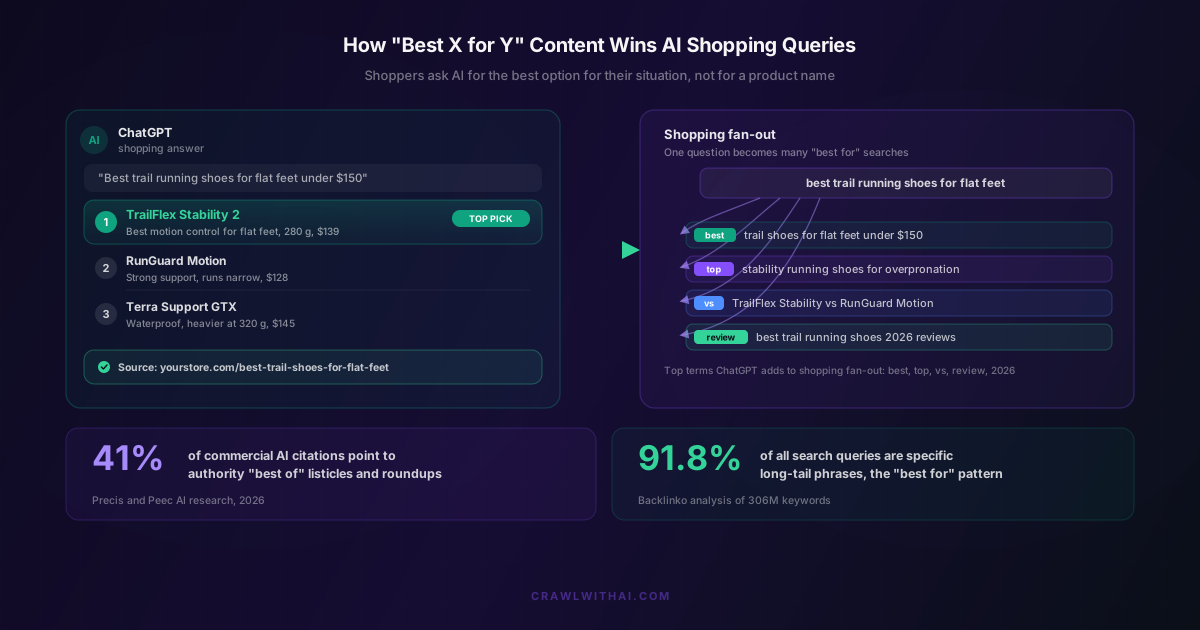
A shopper opens ChatGPT and types "best trail running shoes for flat feet under $150." The answer comes back as a ranked shortlist. One shoe at the top, marked as the best pick with a one line reason, then two more and a link to the page it came from. Nobody typed a brand name. Nobody opened a product page. The decision was mostly made before your store entered the picture.
This is how a growing share of shopping starts now, and it runs on one query shape. Not "trail running shoes," the head term your product page targets, but "best trail running shoes for flat feet," a use case wrapped in the word best. Best X for Y content, the pages built to answer "best [product] for [situation]," is the format the engine reaches for. Build it and you get named. Skip it and the engine assembles its shortlist from a competitor who built it instead.
Why best X for Y is how people shop through AI now
People do not ask AI for a product. They ask it to solve a problem, and the problem always has a qualifier. Best for flat feet. Best for sensitive skin. Best under a hundred dollars. The pattern is always the same: a product category, then a "for whom," "for what," or "for how much."
This is not a niche behaviour. McKinsey's Consumer AI Discovery Survey from December 2025, reported by Precis, found that 63 percent of European consumers use AI to compare brands, models, prices and reviews, and 46 percent use it to discover products. That is mainstream shopping, and almost every session is a "best X for Y" question in disguise.
The query shape is not new, it is what people always wanted to search but rarely typed. Backlinko's analysis of 306 million keywords with DataForSEO found that 91.8 percent of all search terms are long tail, the specific phrases that describe an exact need. On Google, people shortened those to a head term and filtered the results themselves. AI removes that friction. You say the whole messy sentence, the model does the filtering, and the long tail that used to hide in people's heads comes out as "best X for Y."
What AI actually does with a best for query
When you ask ChatGPT a shopping question, it does not answer from memory. It fans the question out into smaller searches first. Peec AI's research, in Precis's teardown of ChatGPT Shopping, analysed more than a million of these fan-out queries. A prompt like "best running shoes under 150 euros" breaks into product focused searches, and what comes back populates the answer.
The revealing part is which words the model adds. The top terms ChatGPT appends across e-commerce are "best," "review," "2026," "top," "comparison," and "vs." Those are not random, they are the words in the titles of "best of" roundups, review posts and comparison pages. The engine is searching for best X for Y content on your behalf, then building its shortlist from what it finds. Our breakdown of what GPTBot actually reads when it crawls your Shopify store covers how those fragments get pulled in. So when the engine runs "best trail shoes for flat feet 2026," either a page from your store is in the results, or only the stores that thought to write one.
Why your product page loses to a best X for Y page
Your product page describes one product. It tells the engine what you sell. A best X for Y page ranks a field of options for a specific use, names a winner, and explains who each pick suits. It answers the question the shopper actually asked, "which one should I buy," not "what does this store stock."
The citation data is blunt about which one wins. Precis, summarising where commercial AI citations come from, reports that authority listicles, the "best of" roundups, account for 41 percent of citations on commercial queries. A product page cannot rank a field, it can only present itself. At the moment a shopper is choosing, the engine needs a page that weighs options, and the roundup is that page.
This is close to, but not the same as, a head-to-head comparison, which pits two named products against each other, X vs Y. Our guide to how comparison content gets your store cited in AI answers covers that format. A best X for Y page instead ranks a field for one use case, catching the wider "best for" net. You want both.
The two ways to win a best for query
You can show up in two places when someone asks AI for the best option: your own roundup, or someone else's.
The one you control is your own. Publish "best [category] for [use case]" pages that include your product honestly, alongside real alternatives. This is the piece most founders get wrong. A roundup that only lists your own products is an advert, and the engine treats it as one. Name competitors, and sometimes rank them above you, or the page earns no citation.
The other place is third-party lists: the press pieces, niche blogs, YouTube roundups and Reddit threads that already rank products in your category. Getting into those is slower, but it is where much of that 41 percent of listicle citations lives. Our piece on how D2C brands build topical authority covers earning those mentions at scale.
Anatomy of a best X for Y page AI will cite
Name the use case in the title and the URL. "Best trail running shoes for flat feet," not "our shoe collection." The engine matches its fan-out query to your page, so make your H1 the query.
Lead with the pick. Put the ranked shortlist and the top pick in the first screen, not under 500 words of background about pronation. Kevin Indig's analysis of 1.2 million ChatGPT answers found that 44.2 percent of citations come from the first 30 percent of a page. The model reads the top and often stops, so a verdict buried under a preamble never gets extracted.
Fill the page with specifics, not adjectives. A Princeton led study called GEO: Generative Engine Optimization tested what raises a page's visibility in AI answers and found that adding statistics, quotations and cited sources lifted it by up to 40 percent. "The TrailFlex holds a neutral gait at 280 grams for $139" is quotable and attributable. "These shoes are really supportive and comfy" is not. Give weights, prices, materials and test numbers in every entry.
Put the ranking in real text, a list or an HTML table, never a screenshot. The engine reads a table as structured rows it can pull cell by cell, and an image of a table as nothing. Keep the order honest. Say who each pick is best for, and name the one thing each does worst. The balanced roundup is the one the engine trusts, and the one that reads like a guide instead of a pitch.
Build a best for matrix, not a single page
One roundup is a start. The real win is a grid. Cross your category with every qualifier your buyers use. For running shoes that is flat feet, overpronation, wide feet, beginners, ultramarathons, and price bands like under 100 and under 150. Each cell is a "best X for Y" query with almost no Google volume of its own, so nobody writes a dedicated page for it, and the AI engine sees it constantly with thin material to answer. Fill that grid with honest roundups and you become the source the engine returns to across the category. That is topical authority, and it compounds. Interlink the pages so shoppers and crawlers can move between them without leaving your store.
One detail from the fan-out data: "2026" is a term ChatGPT adds often, so date your roundups and refresh them. Our piece on how seasonal intent changes what AI recommends explains why freshness matters more in AI answers than in classic search.
The technical steps that decide if it pays off
Two things quietly break the whole effort. First, the page has to be reachable. A surprising number of Shopify stores block AI crawlers by accident in robots.txt, and a roundup GPTBot cannot fetch earns zero citations. Our post on the Shopify robots.txt settings that block AI crawlers walks through the fix.
Second, mark the page up and link out from it. Add structured data so the crawler classifies the list correctly, and link every product you name to its product page with descriptive anchor text. The link carries the shopper to checkout and lets you attribute the sale. Our guide to using Shopify's JSON-LD output for AI SEO covers the markup.
The reason to bother is the traffic quality. Adobe, reporting in March 2026, found that traffic from AI assistants converts 42 percent higher than non-AI traffic, because someone asking for the best option is already at the decision. Best X for Y content puts you in front of that shopper as they choose.
How CrawlWithAI shows which best for pages get cited
Here is the gap that undoes most of this work. You can publish the perfect best X for Y roundup and have no way to know whether ChatGPT is citing it. Google Search Console shows the Google side and nothing about AI. Shopify Analytics files most AI-referred buyers under direct traffic, so the roundup that earned the recommendation gets no credit. Standard SEO tools count backlinks and rankings, not AI citations.
CrawlWithAI is a Shopify app built to close that gap. It runs continuous shopping queries against ChatGPT, Perplexity and Gemini for the terms your store cares about, records which of your URLs get cited, and matches those citations to revenue with a fingerprinting layer that survives the loss of referrer data. For a store building a matrix of "best for" pages, that answers the only question that matters: which roundups are being cited, on which queries, and how much revenue each one drives. Our piece on organic search versus AI-referred traffic explains why the standard tools miss it.
FAQ
What is best X for Y content?
It is any page that ranks a field of products for a specific use case, built so an AI engine can lift the winner. Think "best [category] for [persona, situation, or budget]," like best running shoes for flat feet. The defining feature is an honest ranking with a clear top pick and specific reasons, not a spec sheet and not a list of only your own products.
Should my own best for roundup include competitors?
Yes. A roundup that lists only your products reads as an advert, and AI engines discount it. Name real alternatives, rank them fairly, and say who each pick suits. The honest page earns the citation, and still puts your product in front of the shopper at the decision point.
How is best X for Y content different from a comparison page?
A comparison page pits two named products head to head, X vs Y. A best X for Y page ranks several products for one use case and names a winner. Both get cited, but they catch different queries. The comparison answers "should I buy A or B," the roundup answers "what is the best one for my situation."
How many best for pages does my store need?
Start with the three or four use cases your buyers care about most, then expand into a grid that crosses your category with every qualifier they use. Each cell has low search volume, so the pages are cheap to own and the AI engine has little else to cite. A dozen honest, interlinked roundups usually beat a hundred thin posts.
Do best for pages help Google rankings too?
Yes. The same page that names a use case, leads with a verdict, uses a real table and cites specifics tends to rank in Google's results and its AI Overviews while getting cited by ChatGPT and Perplexity. You write it once and earn from every channel, which is the point.
Sources
- Precis, "How ChatGPT shops: What the research reveals about AI product recommendations" (2026), reporting Peec AI fan-out research and McKinsey Consumer AI Discovery Survey data: https://www.precis.com/resources/how-chatgpt-shops-what-we-found-why-it-matters-and-what-to-do-about-it
- Backlinko, "We Analyzed 306M Keywords: Here's What We Learned About Google Searches," with DataForSEO: https://backlinko.com/google-keyword-study
- Aggarwal et al., "GEO: Generative Engine Optimization" (Princeton, Georgia Tech, Allen Institute for AI): https://arxiv.org/abs/2311.09735
- Passionfruit, "How LLMs Search for Citations: What They Find" (2026), reporting Kevin Indig's analysis of 1.2 million ChatGPT answers: https://www.getpassionfruit.com/blog/how-llms-search-for-citations-what-they-look-for-and-what-they-actually-find
- Adobe, "AI-driven traffic surges across industries, retail sees biggest gains" (2026): https://business.adobe.com/blog/ai-driven-traffic-surges-across-industries