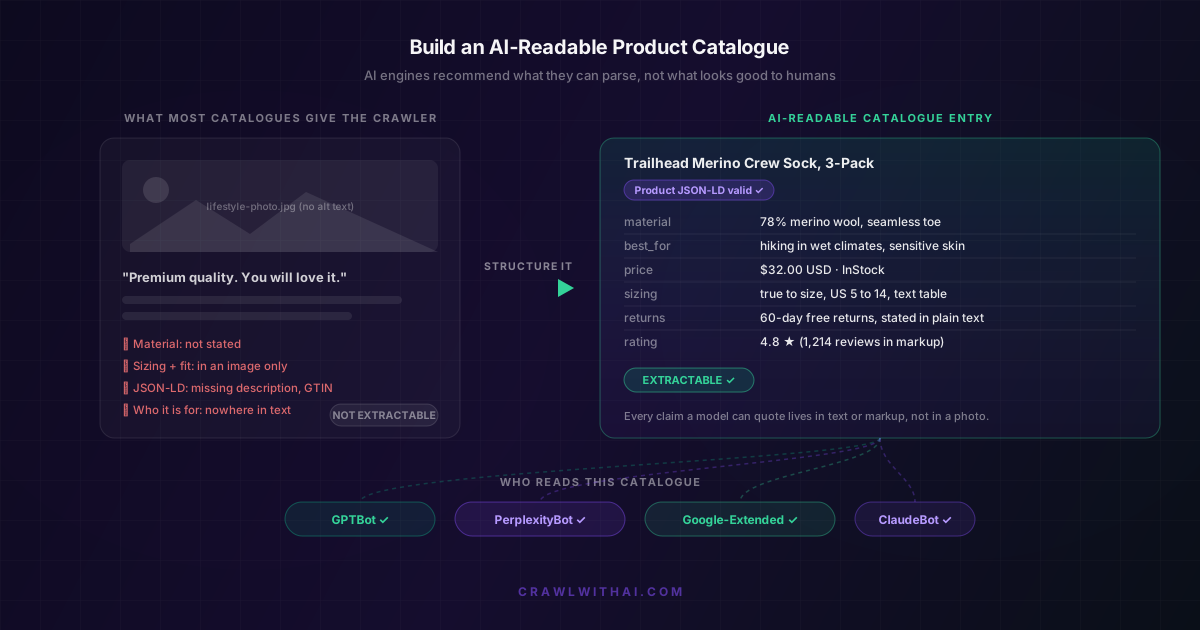
Your product catalogue was built for two readers: humans scrolling on a phone, and Google's ranking algorithm. Both readers tolerate vagueness. A human fills the gaps with photos and vibes. Google fills them with backlinks and behavioural signals. So D2C brands learned to sell with imagery, mood, and copy like "premium quality, you will love it," and it worked.
There is now a third reader, and it tolerates nothing. When ChatGPT, Perplexity, or Gemini decides whether to recommend your product, it works from what it can extract from your pages as text and structured data. If your fabric composition lives in a photo, it does not exist. If your sizing guide is an image, you have no sizing guide. The brands winning AI recommendations in 2026 are not the ones with the prettiest pages. They are the ones with an AI-readable product catalogue, and most of their competitors have not started building one.
What an AI-readable product catalogue actually is
An AI-readable product catalogue is the full set of your product information, expressed so a machine can extract every meaningful fact without guessing. That means three layers working together. Plain-language text that states what the product is, what it is made of, who it is for, and who it is not for. Structured data, primarily Product JSON-LD, that mirrors those facts in a format crawlers parse natively. And consistent attribute coverage across the whole catalogue, so the engine learns your range, not just your bestseller.
The test is simple. Take any claim you would make to a customer on a sales call, then ask whether a crawler reading your raw HTML would find that claim as text or markup. "Our serum is fragrance free" passes if it is written in the description and listed in your markup. It fails if it only appears in an Instagram-style graphic your designer made. AI engines do not study your photography. As we covered in what GPTBot actually reads on your store, the crawler consumes rendered text, headings, tables, and JSON-LD. Everything else is decoration.
Why this matters more for D2C than anyone else
Marketplace sellers get structure for free. Amazon forces every listing into attribute fields, bullet specs, and a category tree, which is part of why AI assistants find marketplace data easy to use. A D2C store on its own domain has no such discipline imposed on it. Your catalogue structure is whatever your theme and your copywriter produced, and for most brands that is a hero image, three paragraphs of brand voice, and a buy button.
That gap is expensive precisely because the channel is growing so fast. Adobe Analytics found that traffic from generative AI sources to US retail sites grew 1,200 percent between July 2024 and February 2025, and Adobe's surveys showed shoppers using AI for research and recommendations, not just chat. Semrush's research on AI search found those visitors convert at roughly 4.4 times the rate of traditional organic search visitors, because they arrive pre-qualified by a conversation. High-intent buyers are being routed by machines that read catalogues. The D2C brands that feed those machines clean data collect the recommendations, and the rest donate their categories to whoever does. The upside, as we showed in how D2C stores with no backlinks still win AI recommendations, is that this game does not require authority. Ahrefs' study of 75,000 brands found backlinks correlate with AI visibility at just 0.218, while brand mentions hit 0.664. Readability and specificity are the levers, and both are fully in your control.
The attributes AI engines actually extract
When an engine evaluates your product against a query like "merino hiking socks for sensitive skin under $35," it is hunting for attributes: material, use case, audience, price, availability, sizing, care, country of origin, and the constraints your product satisfies. Every attribute you state is a query you can match. Every attribute you omit is a filter that silently eliminates you.
Audit one bestseller and list what a crawler can extract. Most D2C pages yield a title, a price, and adjectives. The composition is in a photo of the label. The fit guidance is in an image-based size chart. The "great for travel" claim is in a graphic carousel. The page convinces a human in thirty seconds and tells a machine almost nothing. This is the same failure mode we described in why most Shopify product descriptions fail to convert, except here the cost is not a lower conversion rate. It is total invisibility for that attribute.
JSON-LD is the skeleton of an AI-readable product catalogue
Structured data is where readability stops being a writing exercise and becomes an engineering one. Shopify themes output basic Product JSON-LD by default, but "basic" is the operative word: name, price, image, and often little else. A serious AI-readable product catalogue fills the schema out. A real description in the markup, not a truncated string. GTIN or MPN where they exist. Brand. AggregateRating pulled from your actual reviews. Availability that updates with inventory. Material, color, size, and pattern properties where the schema supports them.
This is not speculative. OpenAI's own merchant documentation for ChatGPT shopping points to product feeds and structured metadata as inputs, and Google has said for years that markup helps it understand product data for both search and AI surfaces. We walked through the broader shift in how structured data changed e-commerce SEO. On Shopify, the practical path is metafields. Define metafields for the attributes that decide purchases in your category, fill them for every product, and use a theme or app that injects them into both visible text and JSON-LD. Done once, this upgrades the entire catalogue, and it keeps your product feed quality consistent across Google Shopping and AI engines at the same time.
Write descriptions a model can quote
The text layer matters as much as the markup, because assistants quote sentences, not schema. The catalogue entries that win recommendations contain sentences an engine can lift verbatim into an answer: "These socks are 78 percent merino wool with a seamless toe, made for hiking in wet climates, and run true to size from US 5 to 14."
That sentence answers material, use case, construction, and fit in twenty-six words. Write one like it for every product. Then add the two things brand copywriters resist: numbers and exclusions. "Cushioned but not compression rated" or "not suitable for machine drying" reads like a flaw to a marketer and like trustworthy precision to a model deciding whether you match a constraint-heavy query. Vague superlatives give the engine nothing to match. Specifics give it reasons to pick you.
Cover the whole catalogue, not just the heroes
Brands optimise their top five products and leave the long tail as stubs with a photo and a price. AI engines punish this twice. First, long-tail products are exactly what constraint-heavy AI queries surface, because a specific question often matches a niche SKU rather than a bestseller. Second, the engine builds its model of your brand from your whole site. A catalogue where 80 percent of entries are thin tells the engine you are a thin brand.
Consistency beats brilliance here. Every product should reach the same floor: stated material or composition, stated audience and use case, plain-text sizing or dimensions, availability in markup, and at least one quotable sentence of specifics. Collections need the same treatment, since collection pages are how engines understand your range, as we covered in how Shopify collections should be structured for visibility. And keep availability honest in the markup, because engines do check, and how AI handles out-of-stock products is not in your favour if your data lies.
Policies and trust signals are part of the catalogue
A buyer-facing assistant is accountable for its recommendation, so it favours stores where the full transaction is legible. Shipping costs and times, return windows, and warranty terms are catalogue data in the engine's eyes, even though no merchandiser thinks of them that way. If your returns policy is a PDF or a vague "easy returns" badge, the engine cannot verify the claim, and a competitor whose page says "60-day free returns, prepaid label included" in plain text becomes the safer answer.
The fix costs an afternoon. Put concrete policy facts in crawlable text on the relevant pages, link them from product pages, and mark up shipping and returns with the schema Google and OpenAI both document. It is the cheapest visibility upgrade in this entire post.
How CrawlWithAI shows whether your catalogue is actually readable
The hard part of all this is feedback. You can rewrite descriptions, fill metafields, and fix markup, and still have no idea what an engine extracts from the result, or whether any of it changed what ChatGPT says when a buyer asks for your category. Shopify Analytics will not tell you. Search Console will not either.
CrawlWithAI is a Shopify app built for exactly this loop. It audits your store the way AI crawlers see it, page by page, flagging products with thin extractable text, missing or hollow JSON-LD, and attributes locked inside images. Then it runs your real buyer queries against ChatGPT, Perplexity, Gemini, and Copilot on a schedule, records whether your products get recommended and which URL the engine cited, and ties those citations to orders and revenue. You see which catalogue fixes earned recommendations and what those recommendations are worth, instead of optimising blind.
FAQ
What does "AI-readable" mean for a product catalogue?
It means every meaningful product fact exists as machine-extractable text or structured data. Material, audience, use case, sizing, price, availability, and policies are stated in plain sentences and mirrored in Product JSON-LD, rather than living in images, graphics, or vague copy a crawler cannot interpret.
Is this different from normal SEO for product pages?
It overlaps but is not the same. Traditional SEO optimises for keywords and ranking signals like links. An AI-readable catalogue optimises for extraction: complete attributes, quotable sentences, and full structured data, so a language model can match your product to a specific question and defend the recommendation. Good AI readability usually helps SEO, but pages can rank on Google and still be unreadable to AI engines.
Where should a D2C brand start?
Audit one bestseller against one real buyer query. List which attributes in the query exist on your page as text or markup. Then fix in this order: write one specific, quotable sentence per product, move facts out of images into text, fill out Product JSON-LD via metafields, and put shipping and returns terms in crawlable plain text.
Do I need a developer to do this on Shopify?
Mostly no. Descriptions, metafields, and policy pages are admin-level work. You may need light theme help to inject metafields into your JSON-LD output, or an app that does it, but no custom build is required for the bulk of the value.
How long until catalogue changes show up in AI recommendations?
Engines that browse live, like Perplexity and ChatGPT with search, can reflect changes within days to a few weeks as they recrawl. Recommendations drawn from model training move slower, over months. Track your real queries weekly so you can see movement instead of guessing.
Sources
- Adobe Analytics, "Traffic to US retail websites from generative AI sources": https://business.adobe.com/blog/the-latest/adobe-analytics-traffic-to-retail-travel-and-financial-services-sites
- Semrush, "AI Search Visitors Convert at a Higher Rate": https://www.semrush.com/blog/ai-search-traffic-study/
- Ahrefs, "An Analysis of AI Overview Brand Visibility Factors (75K Brands Studied)": https://ahrefs.com/blog/ai-overview-brand-correlation/
- OpenAI, "Merchants and shopping in ChatGPT": https://chatgpt.com/merchants
- Google Search Central, "Product structured data": https://developers.google.com/search/docs/appearance/structured-data/product