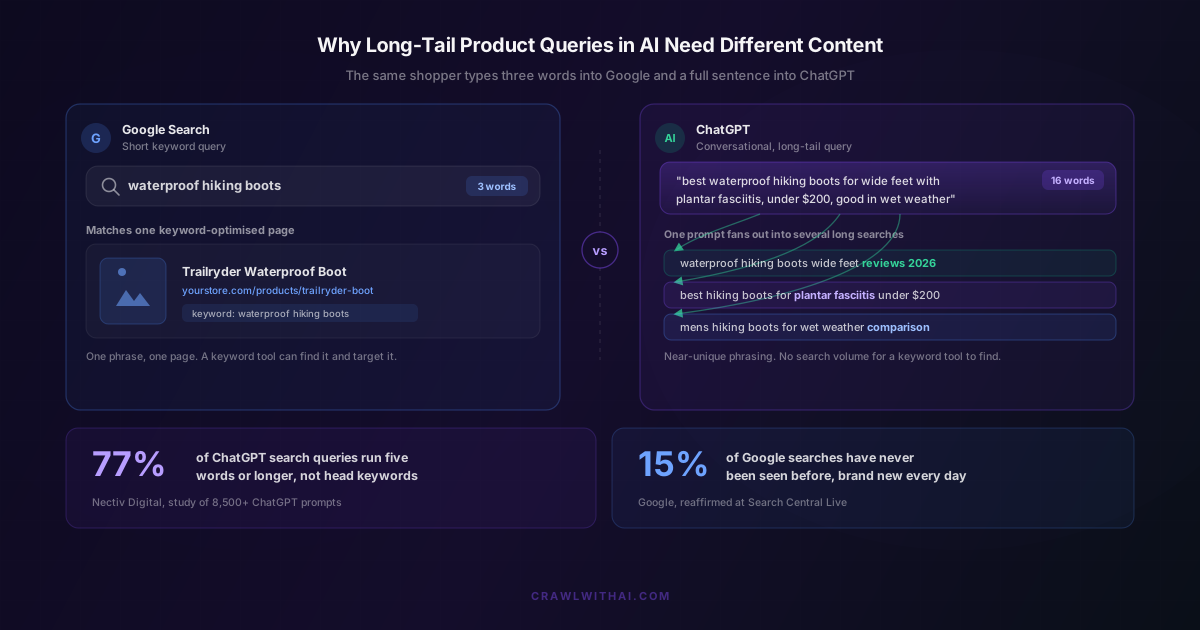
A shopper wants hiking boots. On Google she types three words: "waterproof hiking boots." On ChatGPT, same person, same afternoon, she types a full sentence: "best waterproof hiking boots for wide feet with plantar fasciitis, under $200, that hold up in wet weather." Two tools, one buyer, two completely different query shapes. Your store has a product page built for the first one. It has almost nothing built for the second.
That gap is the whole problem. The pages you optimised for Google target head keywords and the shortened phrases people type into a search box. Long-tail product queries in AI are a different shape: longer, messier, closer to speech, and often so specific that no two shoppers phrase them the same way. Answer the AI version and you get named at the moment someone decides what to buy. Keep writing only for the Google version and the engine assembles its answer from a competitor who wrote for the sentence, not the keyword.
Long-tail queries mean something different in AI
On Google, the long tail was always there, but it hid. People wanted to type the whole need and rarely did, because they had learned that a search box rewards short, telegraphic terms. So "best waterproof boots for wide feet" got shortened to "waterproof boots," and the shopper filtered the results herself.
AI removed that habit. The queries are long by default. Semrush's July 2025 study of nearly 69 million search sessions found the average traditional Google query runs about 4.0 words, the average Google AI Mode query stretches to 7.22 words, and the average ChatGPT prompt lands near 23 words. When ChatGPT runs its own searches behind the scenes, a Nectiv Digital study of more than 8,500 prompts found those queries average 5.48 words, 61 percent longer than Google's 3.4-word norm, and 77 percent carry five words or more. The long tail stopped being the exception. It became the default input.
Why the AI long tail has no bottom
The classic long tail had a floor. You could still list the phrases, check their volume in a tool, and pick the ones worth a page. Conversational input removes that floor. When people speak their whole situation into a chat box, they combine constraints in ways that are close to unique. Wide feet plus plantar fasciitis plus a price cap plus wet weather is one query. Swap any constraint and it is a different one.
Google has quietly told us how big this space is for years. Roughly 15 percent of searches it sees every day have never been entered before, a figure it has reaffirmed repeatedly and revisited again in the context of AI search. Now push every shopper toward full sentences with three or four constraints each, and the number of distinct phrasings explodes past anything a keyword tool can catalogue. These queries have no volume because most of them are typed once, by one person. You cannot build a page for each phrase. You need a different approach.
Your keyword-matched page does not match a conversational query
Google matched strings. Your product page targets "waterproof hiking boots," and for that head term it may rank well. The AI query is "best waterproof hiking boots for wide feet with plantar fasciitis under $200." The engine is not scanning for your keyword. It is reading for meaning, pulling out the entities that define the need: a width, a foot condition, a price ceiling, a weather use case.
If your page never names a width, never mentions plantar fasciitis, and never states a price in plain text, it is not a match, no matter how high it ranks for the two-word term. This is why stores with strong Google rankings get ignored by ChatGPT: the content is built for keywords the engine is no longer searching. Our breakdown of what GPTBot actually reads when it crawls your Shopify store shows which fragments get pulled and which get skipped.
Query fan-out multiplies the mismatch
AI does not run one search per question. It fans the prompt out into several. Qwairy's study of 102,000 queries found ChatGPT runs an average of 3.51 searches per prompt, with 67.3 percent of prompts triggering more than one. Each of those searches chases a different slice of the original sentence.
So the boots prompt does not become one lookup. It becomes something like "waterproof hiking boots wide feet reviews 2026," then "best hiking boots for plantar fasciitis under $200," then "mens hiking boots wet weather comparison." A page that answers only the first misses the citation chances from the other two. Coverage of the whole constraint family beats a single exact-match page, which is also why comparison content gets your store cited in AI answers more often than a lone product page does.
Even Google now rewards the longer query
This is not a ChatGPT-only shift. Google's AI Overviews trigger far more on long queries than short ones. WordStream's 2026 data found that searches of eight words or more have roughly a 57 percent chance of surfacing an AI Overview and are about seven times more likely to trigger one than a short query. Ahrefs figures show the same slope: near 9.5 percent for a one-word search, rising past 46 percent for seven words or more.
The takeaway is convenient. The same content written for a long, specific, conversational need earns AI Overviews inside Google and citations inside ChatGPT and Perplexity at the same time. Content written only for the short head keyword leaves all of it on the table.
The content that answers long-tail product queries
The old long-tail playbook was mechanical: research low-competition phrases, spin a thin page for each, and stuff the exact match. That worked when the tail had volume and matching was literal. It fails now on all three counts. There is no volume to find, matching is based on meaning rather than exact strings, and thin pages lose to comprehensive ones because fan-out rewards breadth.
Write for the sentence instead. Name the constraints shoppers actually say out loud: the use cases, personas, budgets, materials, and conditions. Be specific and entity-rich, because specifics are what the engine extracts. "Holds a neutral gait at 320 grams in a wide fit for $149" is quotable and matchable. "Really supportive and comfortable" is not. Nectiv found the modifiers ChatGPT appends most are "reviews," on 26.5 percent of its internal queries, and the current year, on 17.7 percent, so include real review detail and date your pages.
Then cover the intent space rather than a single phrase. Deep product descriptions built for AI to recommend, "best for" roundups like the ones in our guide to best X for Y content, and supporting blog content that drives AI product recommendations all pull in different fan-out queries around the same category. That combined coverage is what a conversational query lands on.
How to find long-tail queries a keyword tool will never show
Since the volume is not there, stop starting from a keyword tool. Start from language. Your support tickets, product reviews, on-site search logs, live chat transcripts, and the relevant Reddit and forum threads are full of the exact constraints buyers use, in their own words. That is your source material, not a search volume column.
Turn it into a matrix. Cross your category against every constraint that shows up: widths, foot conditions, budgets, weather, personas, occasions. Each cell is a family of long-tail queries with almost no individual search volume, which is precisely why competitors skip it and the AI engine has thin material to answer. Fill those cells with honest, specific pages and interlink them, and you become the source the engine returns to across the category. That compounding coverage is the mechanism behind how D2C brands build topical authority that AI keeps citing.
How CrawlWithAI shows which long-tail queries you win
Here is the trap. You can write beautifully for the sentence and still have no idea whether ChatGPT is citing you, because these queries are invisible by definition. Search Console reports the Google keyword side and nothing about AI. Keyword tools cannot show volume for a phrase typed once. Shopify Analytics files most AI-referred buyers under direct traffic, so the page that earned the recommendation gets no credit.
CrawlWithAI is a Shopify app built to close that gap. It runs continuous conversational, long-tail queries against ChatGPT, Perplexity, and Gemini for the terms your store cares about, records which of your URLs get cited, and matches those citations to revenue with a fingerprinting layer that survives the loss of referrer data. For a store building coverage across a matrix of specific needs, that answers the only question that matters: which pages get cited, on which long-tail queries, and how much revenue each one drives. Our piece on organic search versus AI-referred traffic explains why the standard tools miss it.
FAQ
What counts as a long-tail product query in AI?
Any specific, multi-constraint request a shopper makes in natural language, usually five words or more. Instead of "running shoes," it is "best running shoes for flat feet and long distances under $140." The defining trait is that it bundles several constraints into one conversational sentence, which is how most people now talk to ChatGPT, Perplexity, and Google AI Mode.
Why do my Google-ranked pages not show up in ChatGPT?
Because the queries do not match. Your pages target short head keywords, while ChatGPT fans a prompt out into several long, specific searches and reads for meaning rather than exact strings. A page that ranks first for "waterproof boots" can still be invisible to "waterproof boots for wide feet with plantar fasciitis," which is the query the engine actually ran.
Can I do keyword research for long-tail AI queries?
Not in the old way. Most of these queries have no measurable search volume because they are near-unique. Start from customer language instead: reviews, support tickets, on-site search, and forum threads. Group the recurring constraints into a matrix of category and use case, then cover each family with one honest, specific page.
How many pages do I need to cover long-tail AI queries?
Fewer than you think, if each one is comprehensive. A dozen deep pages that each cover a full family of constraints beat a hundred thin exact-match pages, because query fan-out rewards breadth and specificity. Map your category against the constraints buyers actually use, then build and interlink one strong page per meaningful cell.
Do long-tail pages help Google rankings too?
Yes. The same specific, well-structured page that gets cited by ChatGPT also tends to trigger Google's AI Overviews, which appear far more often on queries of eight words or more. You write once for the real, detailed need and earn visibility across both AI answers and traditional search.
Sources
- Semrush, "Google AI Mode's Early Adoption and SEO Impact" (July 2025), average query length of 4.0 words for Google, 7.22 for AI Mode, and near 23 for ChatGPT: https://www.semrush.com/blog/google-ai-mode-seo-impact/
- CompetLab, "ChatGPT Search Behavior: How AI Queries Differ From Google" (2026), reporting Nectiv Digital's study of 8,500+ prompts on 5.48-word average queries, 77 percent at five words or more, and modifier frequency: https://competlab.com/ai-visibility/chatgpt-search-behavior
- Nectiv Digital, "What Queries Is ChatGPT Using Behind the Scenes": https://nectivdigital.com/new-data-study-what-queries-is-chatgpt-using-behind-the-scenes/
- Search Engine Land, "Google reaffirms 15% of searches are new, never been searched before": https://searchengineland.com/google-reaffirms-15-searches-new-never-searched-273786
- Qwairy, "102K Queries Query Fan-Out Study" (Q3 2025), ChatGPT averaging 3.51 searches per prompt with 67.3 percent multi-query: https://www.qwairy.co/blog/102k-queries-query-fan-out-study-q3-2025
- WordStream, "Google AI Overviews Statistics" (2026), eight-word queries at a 57 percent AI Overview trigger rate: https://www.wordstream.com/blog/google-ai-overviews-statistics