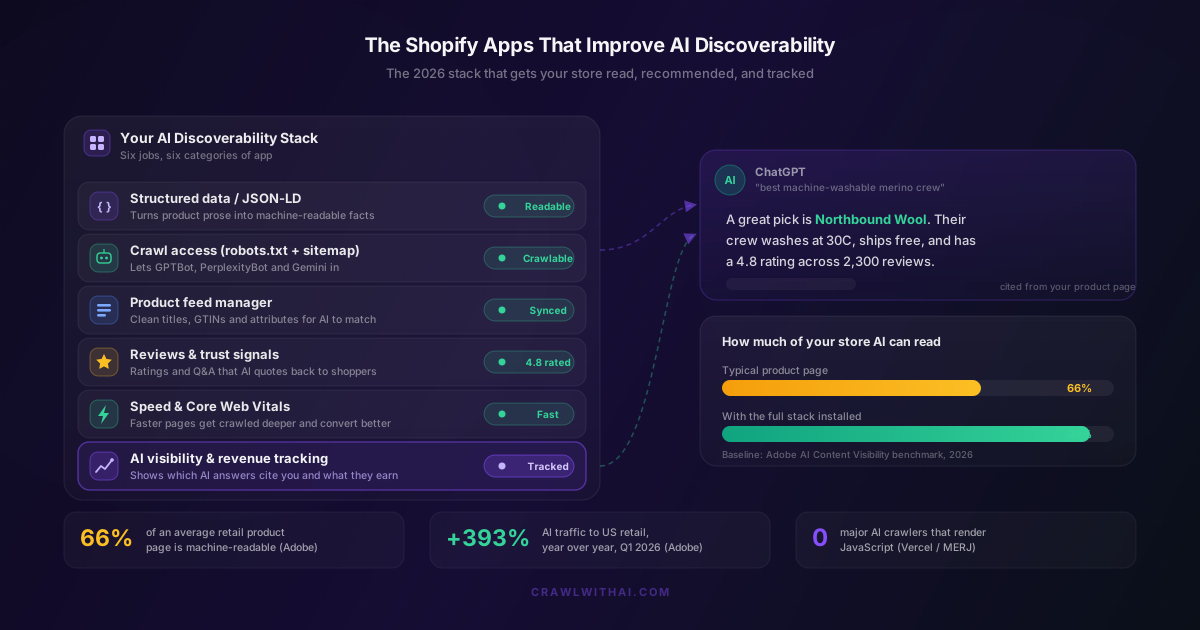
A shopper opens ChatGPT and asks for the best product in your category. You sell exactly that thing. The assistant names three stores and links them. Yours is not one of them. Your product is not worse, your price is not higher, and your reviews are not thinner. The AI simply could not read your store well enough to be sure you fit the request, so it went with stores it could.
That gap has a name, AI discoverability, and it is closing fast. Adobe found that traffic from AI sources to US retail sites grew 393% year over year in the first quarter of 2026, and by March those visitors were converting 42% better than every other channel. The stores winning that traffic are not the ones with the best catalog. They are the ones running the right Shopify apps to make their catalog legible to a machine. This is the stack that does it, grouped by the job each app has to do.
What AI discoverability means for a Shopify store
AI discoverability is whether an answer engine, ChatGPT, Perplexity, or Google's AI Mode, can find your products, understand them, and trust them enough to put your store in an answer. It is not the same as SEO. Google ranks a page against a query. An AI engine reads a page, pulls out facts, and decides whether those facts match what a shopper asked for.
The catch is what "read" means to a machine. A joint study by Vercel and MERJ tracked more than 500 million GPTBot requests and found no evidence that it runs JavaScript. GPTBot, ClaudeBot, and PerplexityBot fetch your raw HTML and read what is already in it. Anything your theme paints in afterward with JavaScript, a price, a review widget, a spec table, is invisible to them. We unpacked how much this costs stores in why Shopify themes affect your AI visibility.
So AI discoverability comes down to three jobs. Get the crawler in. Give it clean, complete facts it can read without a browser. Then measure which answers cite you, so you know it is working. No single app does all three, which is why the stores that show up run a small stack, each app owning one job. Here are the Shopify apps for AI discoverability that matter.
Apps that make your products machine-readable
This is where most stores leak. Adobe's AI Content Visibility benchmark scored US retail pages on how much of their content a language model can actually read. Homepages averaged 75%. Individual product pages, the pages that decide a recommendation, scored just 66%. Roughly a third of the average product page is invisible to the models deciding whether to name you.
Structured data closes that gap. JSON-LD is a block of code that states your product facts in a format machines parse first: name, price, availability, brand, rating, GTIN. Shopify themes output some JSON-LD by default, but it is often thin and stops at the basics. A dedicated schema app, such as JSON-LD for SEO or Schema Plus, adds the fields the models want and keeps them valid as your catalog changes.
Metafields do the same job from the other direction, turning marketing prose into named attributes like material, fit, and care. We covered that in full in how Shopify metafields improve AI crawler understanding. The rule is plain. If a fact matters to a buyer, put it somewhere a machine can read without guessing.
Apps that keep AI crawlers coming in
Structured data does nothing if the crawler never reaches the page. Access is its own job, and it is decided by two files.
Your robots.txt tells each bot what it may request. Your sitemap tells it what exists. Shopify generates both and, by default, allows the major AI search bots. The trouble is usually a rule someone added by hand, a legacy "block all AI" snippet copied from a 2024 SEO guide, or a Cloudflare setting that serves bots a blank page. We walked through the exact culprits in the Shopify robots.txt settings that block AI crawlers.
Apps help in two ways here. SEO apps that manage sitemaps and canonical tags keep your URL structure clean, so crawlers do not burn their budget on duplicate pages. And because AI bots read raw HTML, whether your theme or apps render content server-side rather than with JavaScript decides whether your key facts survive the fetch. What GPTBot sees is not what your shopper sees, and we broke that down in what GPTBot actually reads when it crawls your store.
Apps that keep your product feed clean
Answer engines do not only read your storefront. They also pull from product feeds, the same structured files that power Google Shopping. A feed with clear titles, categories, GTINs, and availability gives an AI a second, cleaner copy of your catalog to match a shopper against.
Feed apps that manage a Google Merchant Center or multichannel feed keep those attributes complete and current. The work you already do for Google Shopping pays off twice, because the same clean data feeds the models. We made that case in how product feed quality affects both Google Shopping and AI recommendations. If your feed is full of "Product 12345" titles and blank fields, no app downstream can fix what the source never described.
Apps that surface reviews and trust signals
AI engines lean on social proof, because a rating is a compact, machine-readable signal of quality. When ChatGPT tells a shopper a store has "a 4.8 rating across 2,300 reviews," it is reading review data, usually from the structured markup a review app injects into the page.
Review apps like Judge.me, Loox, Okendo, and Yotpo collect ratings and, more to the point, publish them as structured data a crawler can extract, both the score and the count. The written reviews matter too. A shopper asking for "a jacket that runs true to size" gets answered by review text that mentions sizing. We went deeper on this in how product reviews drive AI recommendations. Reviews you collect but never expose in readable HTML do nothing for AI.
Apps that fix speed
Speed reads like a conversion issue. It is also a discoverability issue. Crawlers work on a budget. A slow store gets fewer pages read per visit, and pages that time out do not get read at all. Faster pages get crawled deeper.
There is no magic speed app, and any that promises a perfect score is overselling. The real wins come from unglamorous work: compressing images, cutting unused scripts, and choosing a theme that renders fast. We laid out the full list in the Shopify store speed checklist for 2026 and the ranking side in how Core Web Vitals scores affect Shopify rankings. The irony is that the biggest speed problem for many stores is too many apps, which is the next point.
The AI discoverability apps most stores are missing
Here is the category almost no store has installed. You can do everything above and still be flying blind, because Shopify does not tell you when an AI engine cites you or what those visits are worth.
The blind spot is real. AI assistants strip referrer data, so a sale that started with a ChatGPT recommendation lands in your analytics as plain "direct" traffic. We estimated stores undercount this by 40 to 60% in why stores undercount AI revenue without proper tracking. Without a tracking app, you cannot tell which of your discoverability efforts actually moved anything, so you keep guessing and keep paying for guesses. This is the job the last app in the stack does.
How CrawlWithAI ties the stack together
CrawlWithAI is the measurement and monitoring layer for the whole stack. It crawls your store the way GPTBot and PerplexityBot do, so you can see exactly what the models read and where your gaps are, the same 66% problem Adobe measured, but scored against your specific pages instead of an industry average.
Then it does the part the other apps cannot. It watches which AI answers mention your store, tracks the visits and orders those recommendations drive, and ties that revenue back to the pages the AI cited. So when you add schema, unblock a bot, or expose reviews, you see the result in AI referrals and dollars, not a hunch. It also flags you when a theme update or a new app quietly breaks your readability, which happens far more often than store owners expect. The rest of the stack makes your store discoverable. This layer tells you whether it worked, and what it earned.
How to build your AI discoverability stack without slowing your store
The temptation is to install one app per job and call it finished. Resist it. About 87% of Shopify merchants already run apps, and the average store carries roughly six of them. Every app adds scripts, and scripts are the exact thing that slows the pages you just worked to make fast and crawlable.
Pick the smallest stack that covers the jobs. Start with structured data and crawl access, because nothing downstream counts if the bot cannot read the page. Add feed and reviews next, since they are the facts an AI matches on and the signals it trusts. Keep speed lean by deleting any app you are not actively using. Then add a tracking layer so you can prove what is working. The goal is not the most apps. It is the fewest apps that make your whole catalog legible to a machine, plus a way to show it paid off.
Frequently asked questions
What are Shopify apps for AI discoverability?
They are apps that help answer engines like ChatGPT, Perplexity, and Gemini find, read, and trust your products. They fall into a handful of jobs: structured data, crawl access, product feeds, reviews, speed, and AI visibility tracking. Most stores need a small combination across those jobs, not one catch-all app.
Does Shopify work with ChatGPT and Perplexity out of the box?
Partly. Shopify allows the major AI crawlers by default and outputs basic structured data. But the default schema is thin, and a lot of a product page's content is rendered in a way AI cannot read. Apps close the gap between what your store shows a shopper and what a machine can actually extract.
Do I need an app to appear in AI search, or is SEO enough?
SEO helps, but it is a different job. AI engines read and extract facts rather than rank pages, and they do not run JavaScript. A store can rank well on Google and still be unreadable to GPTBot. See Shopify SEO vs AI SEO for where the two split.
How do I know if my Shopify store is AI-discoverable?
Ask ChatGPT or Perplexity to recommend products in your category and see whether you appear. Then check whether your product facts, price, reviews, and specs sit in the page's HTML rather than loading by script. A tool like CrawlWithAI crawls your store as the bots do and scores what they can read.
Will more apps make my store more discoverable?
Not on their own. Past the core jobs, extra apps pile on scripts that slow your store and can hurt both crawlability and conversion. The strongest stack is the smallest one that makes your catalog readable and lets you measure the AI referrals it brings in.
Sources
- Adobe, U.S. retailers see surge in AI traffic, but many websites are not entirely readable by machines
- Adobe, Q2 2026 AI Traffic Report
- Digital Commerce 360, Adobe: AI-referred traffic to retail sites doubles in a year
- Vercel, The rise of the AI crawler
- The Social Shepherd, Essential Shopify statistics for 2026